
· · 2026
Comming soon ^-^

Kate Blomgren · giCentre Seminar, City St George's, University of London, 2026 · 2026
This talk presents my research on collaboration, authorship, and credit in the development of interactive exhibits in science museums. Science museums are increasingly shaped by interactive, data-driven visualizations, yet the work behind these public-facing experiences often remains invisible. Drawing on interview studies from my research on collaboration and attribution, I discuss how contributions are negotiated, recognized, and made visible within museum practices. The talk reflects on how gaps in credit-giving are not only organizational, but also design-related. I frame science museums as a rich space for visualization and HCI research, where public understandings of science, expertise, and participation are actively shaped. From this perspective, I argue for designing systems that make contributions more visible, not only to support fairer recognition, but also to open up broader questions about knowledge, authority, and public science communication.
Kate Blomgren · WASP Study Trip to the North of the UK, 2026 · 2026
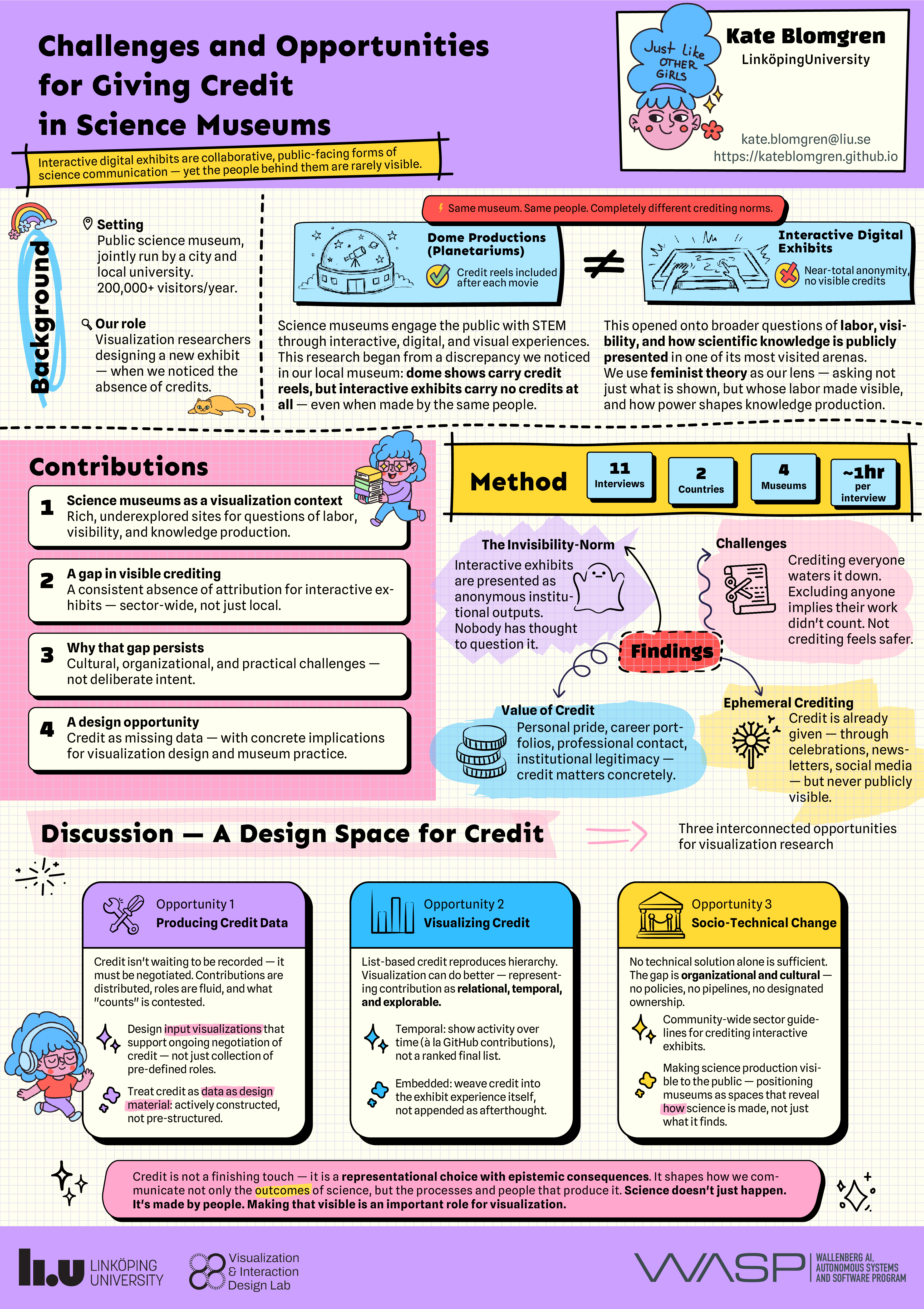
This poster presents ongoing research on credit-giving and authorship in science museums, focusing on the limited visibility of the people who create interactive digital exhibits. The work begins from a discrepancy observed in a local museum context: dome productions often include credit reels, while interactive digital exhibits are usually presented as anonymous institutional outputs, even when they are made by the same people. This opens up broader questions about labor, visibility, and how scientific knowledge is presented in public spaces. The poster frames credit not only as something to be added at the end of a project, but as a representational and organizational challenge. It asks how museums might make the people and processes behind science communication more visible, and what role visualization could play in supporting this work.
Kate Blomgren · WASP Winter Conference, Örebro · 2026
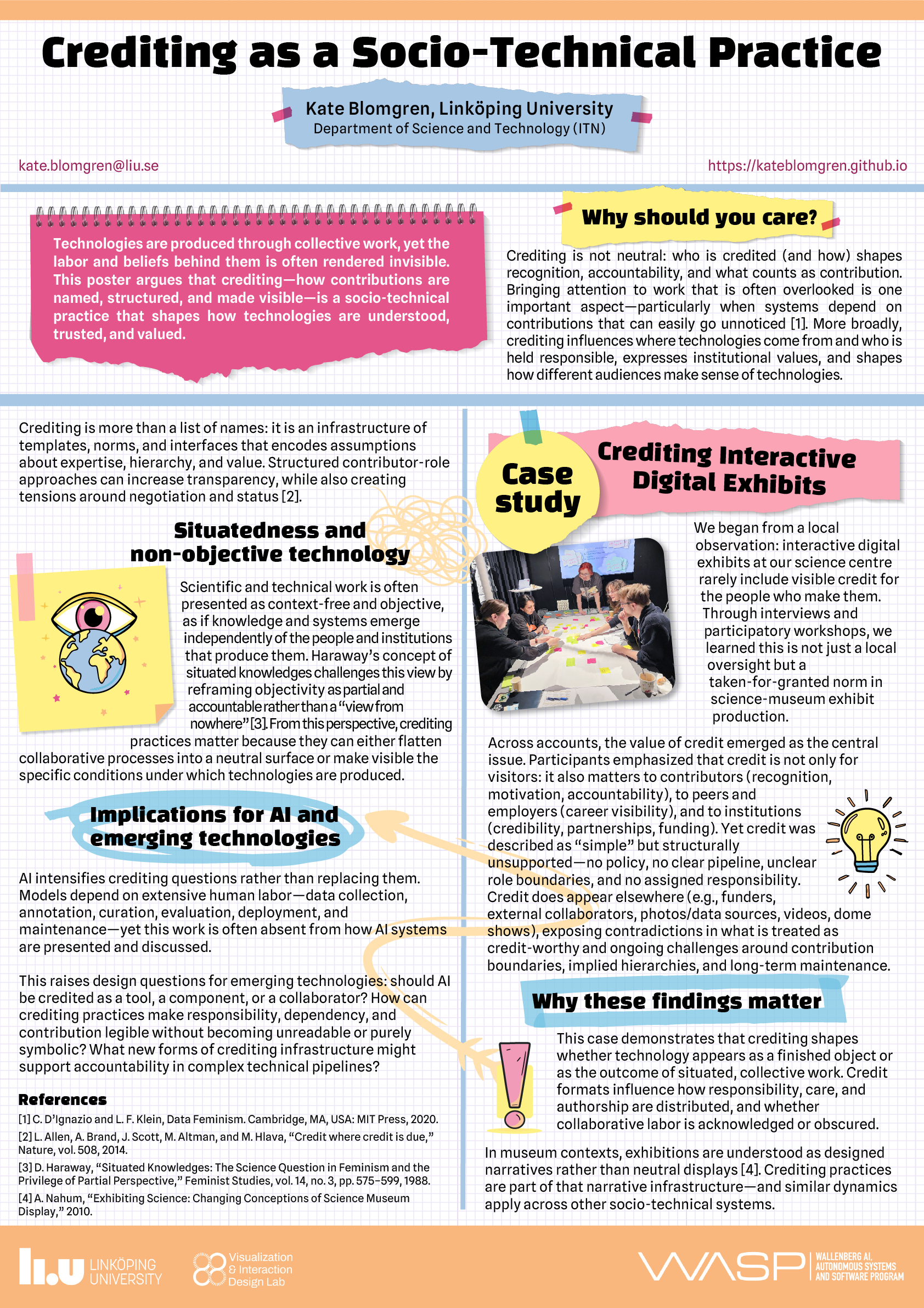
This poster explores crediting in science museums as a socio-technical practice. Science museums are a rich environment for visualization research where researchers have designed new visualizations, interaction modalities, and educational approaches. But they are also socio-technical places where power, context, and organizational structures influence how science communication is produced and perceived. Drawing on a collaboration with a local science museum and an interview study with science museum staff and leadership, this work examines how credit, authorship, and invisible labor are negotiated in the context of interactive digital exhibits. The results reveal crediting of interactive exhibits to be a complex, situated challenge — and an opportunity to reframe credit as a socio-technical design space where visualization can make visible not only the outcomes of science, but the processes and people that produce it. <img src="/news-pics/wasp-poster.png" alt="Presenting the poster" style="max-height: 300px;" />

Kate Blomgren · Master's Dissertation, Uppsala University, 2023 · 2023
While character design and representation have been extensively discussed within feminist discourse, the attention given to game mechanics has been limited. This study aims to challenge the assumption that feminist ideals in video games can only be conveyed through narrative elements and investigate the potential of integrating feminist principles into game design, with a specific focus on game mechanics. Drawing on Bogost's (2007) Procedural Rhetorics theory, which asserts that digital systems can enable the creation of interactive arguments surpassing traditional rhetoric, the thesis examines how mechanics can prioritize inclusivity and diversity. Through critical analysis of existing discourses and semi-structured interviews with game design students who are pursuing a career as industry professionals, the study evaluates the current state of the industry and identifies areas for improvement. Nine interviews were conducted, and thematic analysis using a deductive approach was employed. The study highlights the significance of representation, with participants expressing a preference for strong female protagonists, while also recognizing divergent perspectives on whether the mere inclusion of a female character equates to a feminist game. Player agency during gameplay was not frequently mentioned in the interviews, a topic commonly discussed in scholarly literature. The study calls for clearer guidelines and definitions in the field and proposes two categories: Empowerment and Equality, derived from participant responses. Participants suggested examples of feminist game mechanics related to empowerment (addressing real-life issues and encouraging collaboration) and equality (ensuring equal chances regardless of gender).